Designing for Convergence Across Every Generation

How to Build Experiential Learning That Works Across Every Generation (Part IV)

Three parts in, one truth has held constant across every generation studied: no one wants to be talked at.

Sure, the preferences differ and the priorities shift, but, in the end, the underlying expectation — that learning should be worth the time, connected to real work, and experienced rather than consumed — doesn’t change based on age. It changes based on design.

That’s the premise of this final installment. Not another breakdown of what each generation wants — but a clear-eyed look at where they converge, and how to build one experience that works for all of them at once.

The answer isn’t compromise. It’s convergence.

The Overlap Most Organizations Miss

Organizations that struggle with multigenerational learning tend to over-index on surface-level differences. Those that try either build separate tracks by generation — ending up with fragmented experiences that serve no one particularly well — or default to a large general session, presenting the material and expecting the room to walk out ready to implement.

The more productive question isn’t “what does each generation want?” It’s “where do they all agree?” — because that’s where unified design becomes possible.

Across all four generations, three things hold:

Relevance over volume: Whether it’s a Gen Z filtering for utility or a Baby Boomer screening for credibility, every generation is making the same calculation: is this worth my time? The filtering mechanism differs, but the expectation doesn’t.

Participation over consumption: Gen Z needs interaction baked in. Millennials need collaboration and shared purpose. Gen X needs autonomy and practical application. Baby Boomers need their expertise invited into the room. The motivation behind each is different — but the mechanism is the same. Active participation is the universal language of effective learning.

Connection over isolation: Across every generation in Cramer’s Perspective Series, meaningful peer exchange consistently surfaced as a driver of learning effectiveness. The format preferences differ — younger generations gravitate toward collaborative, informal exchange, while senior leaders value structured, high-trust peer conversation. But the underlying need for human connection is shared.

These three overlaps are where design should start.

Building One Ecosystem That Flexes

The goal of multigenerational learning design is not to build four experiences — it’s to build one that accommodates four different entry points.

That distinction matters. It means shared core experiences with flexible access points, consistent outcomes with adaptable delivery, and a structure that allows each generation to engage on their own terms without pulling the room in different directions.

In practice, this looks like:

Designing the anchor moment for all four: The general session — or any high-attendance learning moment — has to work across the room simultaneously. That means building in real-time interaction for those who need to be doing, not just watching. It means a clear narrative arc with an explicit why for those who need purpose before participation. It means tight, takeaway-driven structure with zero friction for those who are measuring every minute; it also means credibility and contribution for those who bring decades of context into the room.

None of these are mutually exclusive. A well-designed session can do all four — if the intention is there from the start.

Structuring peer exchange with purpose: Facilitated peer discussion is one of the few formats that works across every generation without modification — but only when it’s designed well. That means structured enough to feel purposeful, open enough to invite real perspective, and free from hierarchy so that contribution feels safe regardless of title or tenure. When that environment exists, Gen Z engages because they’re part of something. Millennials engage because they’re building something together. Gen X engages because it respects their time and expertise. Baby Boomers engage because their experience is finally part of the conversation, not sidelined by it.

Letting technology distill, not overwhelm: Across all four generations, the most effective use of technology in learning is reduction — reducing cognitive load, reducing friction, reducing the gap between insight and action. For younger generations, that looks like real-time AI summaries and immediate digital follow-up that keeps momentum alive. For senior leaders, it looks like clean distillation of key takeaways that can be acted on and cascaded across their organizations. Same technology. Same intention. Different expression.

Layering Emotion: Edutainment as Strategic Architecture

Edutainment isn’t about entertainment — it’s about designing learning that lands emotionally, not just intellectually. It should bring energy, surprise, and engagement across generations, reinforcing an overarching narrative while strengthening emotional memory.

The significance behind why edutainment matters can be found post-event, where the most common feeling reported is “inspired” or “motivated.” The challenge isn’t creating that feeling — it’s sustaining it. Edutainment provides the emotional glue that supports long-term recall. This sense of ambition mixed with professional prowess that can amplify the lessons learned and put it into action.

Working best when designed intentionally, edutainment should be structured in acts with clear narrative arcs and thematic storytelling that connects sessions. Well-placed twists maintain anticipation, while wellness elements support cognitive readiness. Experiential lounges with sensory touchpoints — including food and beverage moments — create space for informal connection and reflection, while promoting casual networking experience in an environment geared to development. When learning is emotionally anchored, retention takes care of itself.

The Flywheel Holds

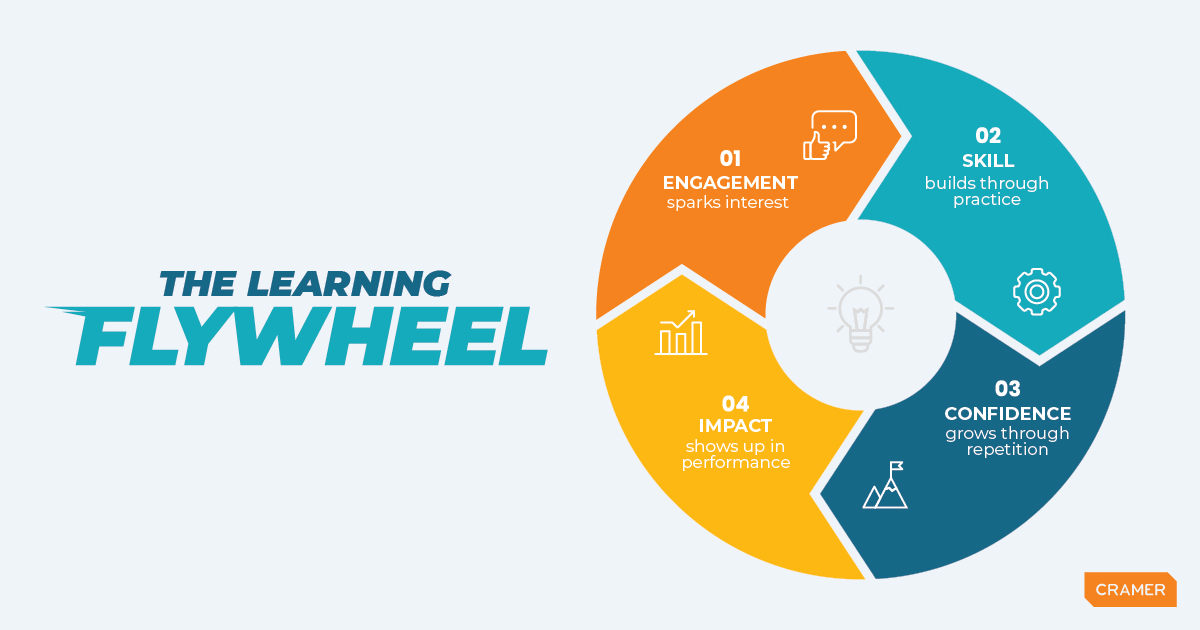
Throughout this series, one model has remained constant:

Engagement → Skill → Confidence → Impact

What this closing piece makes clear is that the flywheel works across all four generations because it’s grounded in human behavior, not age. Engagement starts with relevance. Skill develops through practice. Confidence grows through repetition. Impact shows up when learning transfers into real work.

That sequence doesn’t change by generation. What changes is how you activate the first step — and that’s entirely a design decision.

Design Leads. Demographics Follow.

The most effective learning ecosystems don’t ask people to adapt to the experience. They design the experience to adapt to people.

When design leads, generational differences stop being obstacles and start being assets — distinct perspectives, depths of experience, and ways of thinking that, when brought into the same room with intention, make the learning stronger for everyone.

The future of learning isn’t generational — it’s experiential. — it’s experiential. One ecosystem, designed to turn participation into understanding and connection into action.

The Convergence: Where Generations Move Forward Together: A Shared Experience That Unites Every Generation

Experiential learning doesn’t just bridge generational differences — it turns them into an advantage. It allows people to learn together, grow together, and perform together; reducing friction that would persist if the delivery method of material didn’t properly adhere to each generation.

By building experiences deliberately designed to meet each attendee where they are — regardless of age — organizations boost confidence, strengthen culture, and build capability that lasts.

Teach less. Let people do more. That’s how you move a multi‑generation workforce toward a single, high‑impact future.

Have a project in mind?