(Re)Defining the Sales Kickoff — 2027 Edition

How to build an SKO your reps still use in March

Between now and the end of Q1, your sales org gets one shot at a full reset. A time where strategy turns into story, where teams get aligned, and people remember why they picked this job in the first place — but then come the new year and a new busy season most of it disappears.

According to research presented at IMEX Frankfurt 2026, in-person experiences are becoming more valuable as AI-generated content fills every other channel, yet Cvent found that 90% of event programs face growing scrutiny and only 28% have a solid way to measure what they deliver. Sales kickoffs sit right in that gap. The room can be loud and the keynote can land, but three weeks later your reps are running the same discovery calls they ran in November, your managers aren’t sure what they’re supposed to reinforce, and when finance asks what the event changed, the only answer anyone has is a survey score.

Now, while Applause is not adoption — excitement is not execution.

What Changed For 2027

Your reps are walking into a different job than the one they had a year ago. With constant evolution in the workplace due to factors like AI and shifts in business priorities, these two shifts should shape what goes on the agenda.

Buyers are getting further without your reps. In a Gartner survey of 646 B2B buyers, 67% said they prefer a rep-free experience, which means your reps get fewer conversations and each one has to land.

Your reps are already overloaded. In a separate Gartner survey, 72% of sellers feel overwhelmed by the number of skills their job requires, and 50% by the amount of technology. And according to that same report, overwhelmed sellers are 45% less likely to hit quota. An SKO that announces twelve new priorities will only make that worse.

Three Things Every SKO Has to Do

Miss any one of these and the SKO becomes a moment instead of a movement.

  1. Alignment. Every seller leaves knowing the strategy, why it matters, and what changes in their own week because of it. Not ten priorities, but rather two or three they can repeat back.
  2. Enablement. Skills, messaging, and tools a rep can use on a call the next morning. If it can’t be practiced at the SKO, it probably won’t be adopted after it.
  3. Inspiration. Recognition, purpose, and connection to the people around them. This is the part SKOs already do well. Keep it, but don’t let it crowd out the other two.

Design the Room for Practice

In Salesforce‘s latest State of Sales survey, 75% of reps said they’d be more likely to hit their number with a coach or mentor, and 52% said traditional enablement doesn’t give them the skills they need.
That gap between what reps want and what they get should shape how you design your next SKO, because it’s the one week of the year when every rep and every manager is in the same place, which makes it the best chance you’ll get to give them the coaching and practice they’re asking for.

Make the practice part of the show. The staging, the energy, and the recognition are what make practice feel worth doing rather than like homework, so build the drills into the main experience instead of tucking them into breakout rooms after lunch. Celebrate last year’s wins, and then put people to work on the next ones while the room is still buzzing.

Make it easy to say yes to. Reps, managers, sales engineers, and partners need different depth, so open with one shared session and then split people into tracks built around their role. Deal clinics, live roleplays, and objection drills against real accounts give everyone time on their feet, and AI roleplay can stretch that to the whole room rather than the three brave volunteers on stage.

Hand managers the plan. Managers are the ones who carry the SKO into Q1, and most of them won’t have the time to build a coaching plan from scratch, so send them home with the exact questions, the call-review guide, and the weekly prompts for the first 90 days.

By building this intentional plan, everyone in the room can start to learn and understand the processes you’re putting in place, which aligns the whole team under one strategy and sets up a more impactful year ahead.

Plan the 90 days after, not just the three days of

Without follow-up, most of what reps learn is gone fast. According to another Gartner report, reps forgot 70% of what they’re taught within a week and 87% within a month. The SKO is where the learning starts, but what happens in February decides whether any of it sticks.


So treat the SKO as a production day. Everything you capture on site becomes the reinforcement plan:

  • Short video cuts of the moments that matter, released week by week
  • Microlearning clips for new hires who join in Q2
  • Manager kits with the discussion prompt for each weekly team meeting
  • Recorded deal clinics, turned into a library of what good sounds like
  • Quick knowledge checks built from the live polls

Put the release dates on the calendar before the event. If reinforcement starts “when we get to it,” it doesn’t start.

Measure What Reps Did, Over What They Said

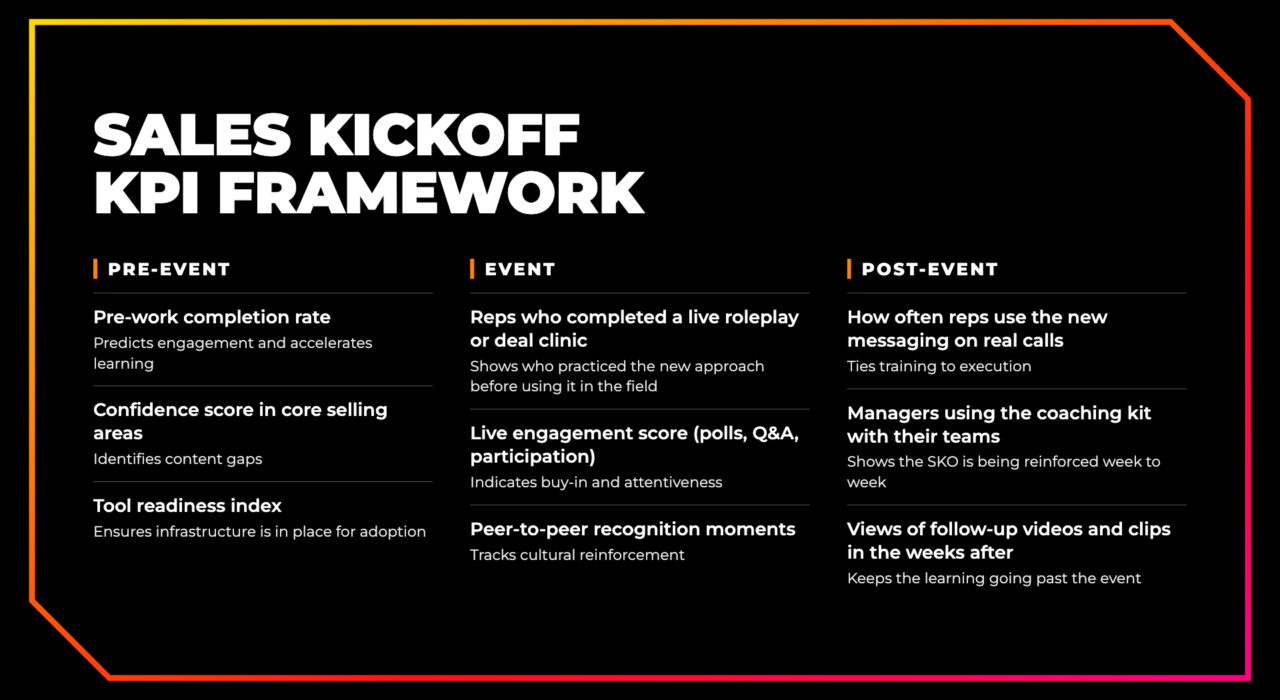
A post-event survey tells you whether people liked the SKO rather than whether it worked. Track the behaviors the event is designed to build instead, starting with what people do in the room and following them through the reinforcement and into the field over the first 90 days.

That gives your CFO an answer built on what people did at the event and in the weeks after, rather than on how loud the room was.

Build the SKO Your Reps Still Use in March

Cramer designs, produces, and measures SKOs that change what sellers do after the lights go down. If your 2027 kickoff is on the calendar, we’ll map the agenda, the practice, and the 90-day plan with you.

Have a project in mind?