Bringing the Show Forward in Time
Our largest studio at Cramer HQ operates as our primary production space — a fully equipped environment built to flex between live broadcasts, hybrid events, presentations, and large-format productions. Cameras, lighting rigs, audio systems, and a 32.5-foot LED wall at full resolution.
That infrastructure exists for client productions. But it also exists for this: running a show before the show exists.
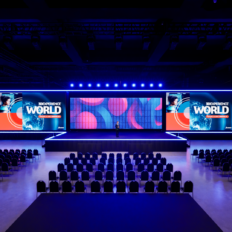
Before an event goes into load-in, our lighting designers use the studio to simulate the experience. By connecting directly to the LED wall — large enough to approximate a 1:1 real-world scale — the team can observe how light and content behave together in a way no monitor can replicate. From there, they run visual content inside a 3-dimensional rendering of the space, testing how light and motion interact across the full environment.
This isn’t a tech check or a rehearsal in the conventional sense, but a deliberate act of seeing, in advance, what an audience will eventually feel — and it’s something we’ve built into how we work across events of all formats and scales.
The questions being answered aren’t whether the technology works, but whether the experience works. How does brightness shift as content changes? How do transitions read across different seating angles? Where does light guide attention, and where does it fight it?
For a format like theatre in the round — where 1,800 or more seats surround a center stage on a flat floor with no front of house to anchor the design — those questions aren’t cosmetic. A 360° opening experience, where a 2.5-minute immersive video triggers lighting changes automatically from a single cue, only works if every angle has been accounted for in advance. Pre-vis is where that accounting happens.