Creative, Production

FM's Client Engagement Conference: Designed to Be One

How a Brand Strategy Became a Room with a Message

Every few years, FM gathers its global workforce in one place. It’s a rare opportunity to recognize people, reinforce culture, and close the distance between a leadership team and the thousands of employees who make the organization run. When it works, people leave the room feeling like they belong to something bigger than their own corner of the business.

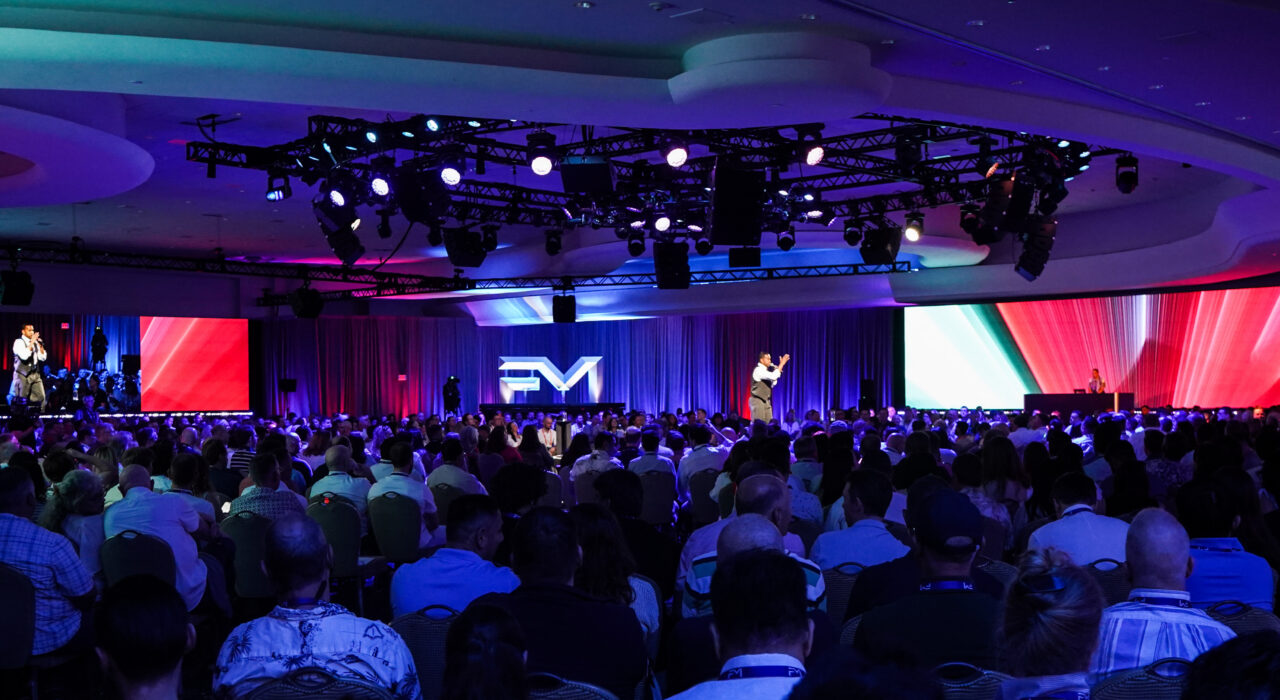
In 2026, FM brought nearly 1,800 attendees per wave to a new Miami venue — a significant increase in scale and a change in geography. The brief wasn’t complicated: make everyone feel equally connected regardless of where they sat, where they came from, or what language they speak. The execution, however, required rethinking the room itself.

Rethinking the Front Row

For events of this size, the default is proscenium: a stage at one end of the room, a screen behind it, and an audience that gets sorted — consciously or not — by proximity to the action. The people in the first twenty rows get a conference. The people in the back get a broadcast. At nearly 1,800 attendees in a rectangular ballroom, that gap becomes harder to paper over with better lighting or bigger screens.

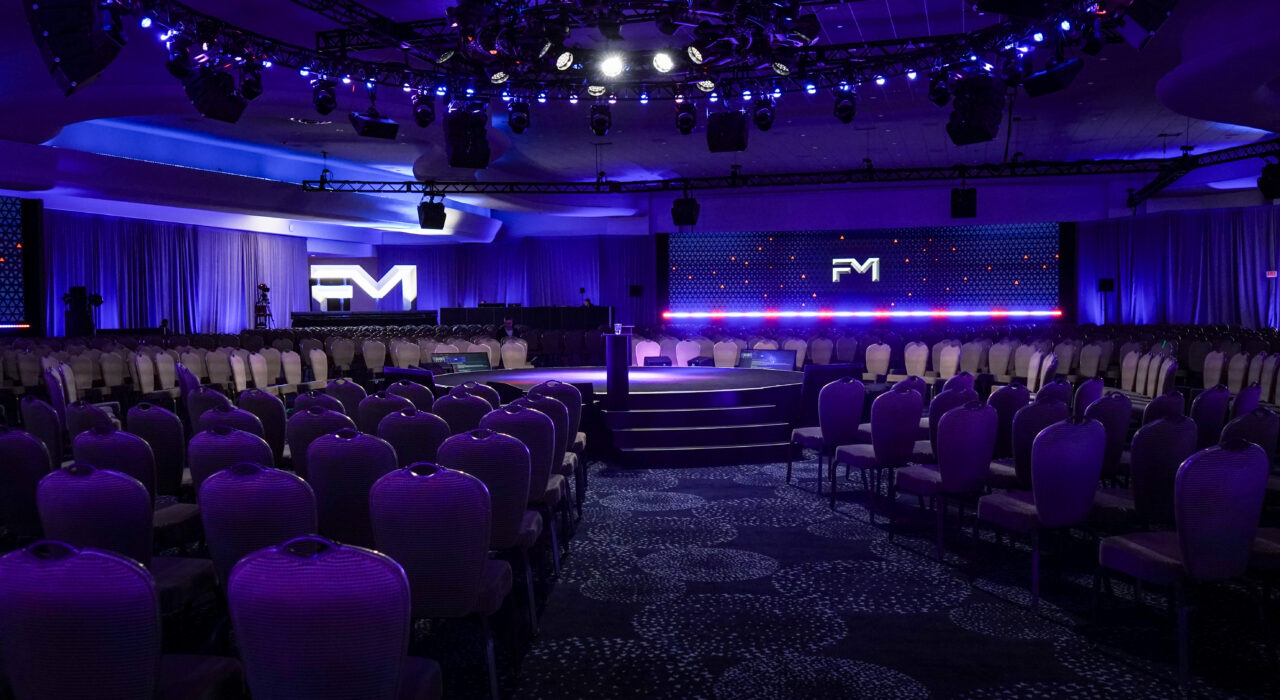
Our creative team’s answer was to eliminate the front row entirely. Theatre-in-the-round brought speakers into the center of the room and surrounded them with audience — no hierarchy of sight lines, no privileged seats, no back of the house.

Creative Director Doug Hodge describes the shift this way: “It became a circle of speakers, a circle of people, and a circle of content. The audience wasn’t just watching the story — they were literally surrounded by it, which is what made the experience feel immersive and intimate at the same time.”

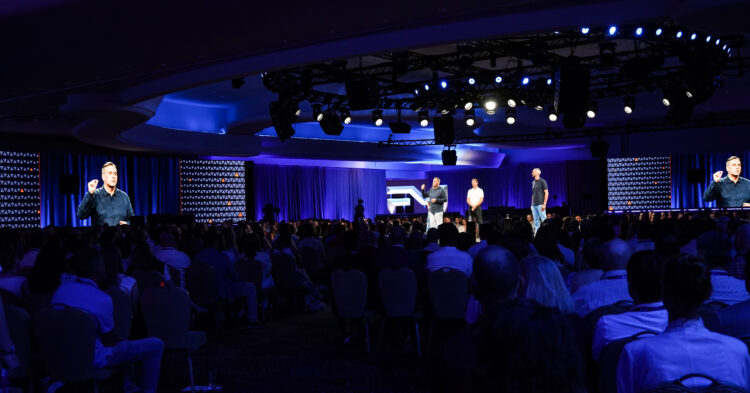
The format also changed what attendees could see. In a traditional setup, you see the stage and whoever’s on it. In the round, you see leadership — and you see your colleagues. At global scale, that visibility does something specific: it makes the shared moment feel real rather than performed.

The theatre-in-the-round brought 1,800 people together around a single message — surrounding them with it and making each attendee feel closer to the center of the experience. It made “One FM” a physical reality, not just a tagline.

Precision at Scale

The concept was right, however, getting it right in execution was variable to conquer.

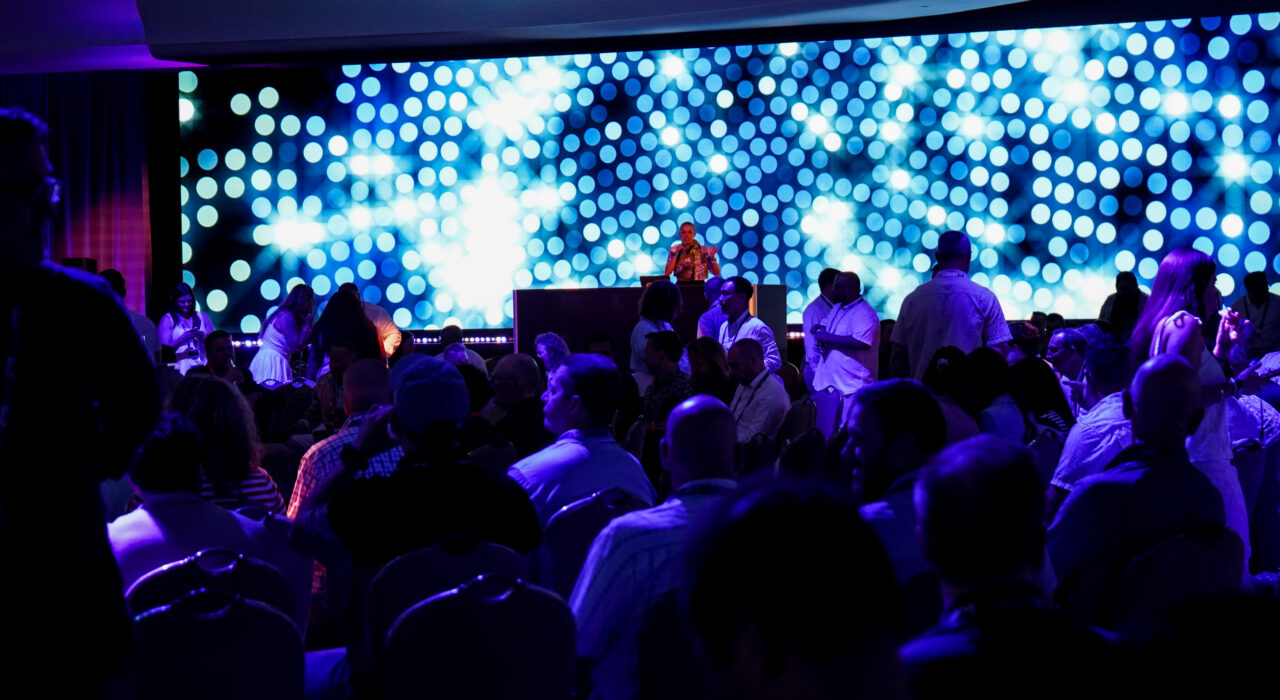
Every venue comes with constraints — irregular geometry, variable ceiling heights — and this venue was no different. Those constraints are where Cramer’s engineering capability earns its place. Four large LED screens were arranged to mirror the circular format of the room, with cameras, content, and speaker movement choreographed so attention moved with the experience rather than against it. As speakers turned to engage different sections of the audience, live video kept every quadrant connected to the message. Sound design was directional. Visuals wrapped the full 360. The result was an environment that gave each attendee an intimate angle on the experience — not because the room was perfect, but because the team knew exactly how to work it.

The visible output is the experience. The invisible work is everything that makes it possible — from directing the audience’s attention organically through engaging video content, to the lighting design that made a circular room feel intimate, to the audio engineering that moved attention across the room like instinct rather than instruction. Both deserved their own treatment — and got it.

Executive Producer Bob Keating puts it plainly: “Planning and preparation were everything. Because we had time to rehearse and refine ahead of time, we walked into the room ready — and that made all the difference.”

That preparation included multiple site visits, speaker rehearsals, and technical run-throughs conducted well before show day — time invested so that no presenter was surprised by the format when it counted. All videos, lighting sequences, and spacial audio were tested at Cramer HQ in order to be sure the technical capabilities could not only support the stage design, but assure the quality of the outcome would be optimal.

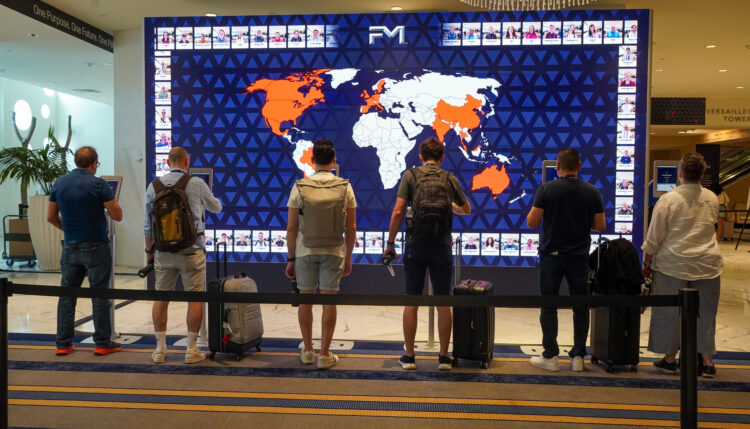
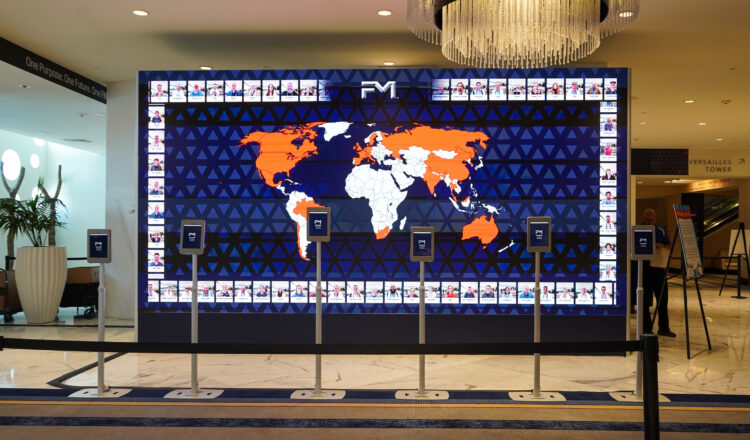
Cramer supported the event end-to-end: scenic design and LED integration in the General Session, a global foyer activation that connected attendees to FM’s worldwide footprint, and technical support across breakout spaces. Each piece of it built toward the same outcome.

The lighting design for this show was solved before the venue existed. Here’s how.
The audio in a theatre in the round doesn’t fill a room — it directs one. Here’s how we engineered it.
The Result Drove Impact

There were no bad seats. There were no disconnected moments. Across every wave, the experience held.

But the more meaningful measure wasn’t logistical. FM’s goal was to deliver a conference that felt celebratory, unifying, and worthy of the people in the room — one that recognized employees not as an audience, but as the story itself. Theatre-in-the-round didn’t just change where people sat. It changed what they were part of.

That distinction — between watching an event and belonging to one — is what good experiential design actually does. With this event series continuity showed in how the work came together: a creative format built to solve for scale, disciplined production engineering that made the format hold, and a partnership grounded in enough mutual trust to make a bold call and execute it without hedging.

Want to see more?