Boston’s World Cup Feeling Wasn’t Confined to the Gates

The World Cup gave us the clearest field study yet of a belief we've built a company around.

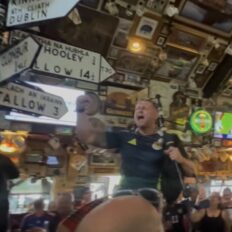
This summer, the Cramer team found themselves surrounded by the World Cup — from the grounds of Boston Stadium to the grass of the Common. Colleen Henderson found her seat for Paraguay vs. Germany with half the section around her in lederhosen. For Scotland vs. Haiti, Kyle Gravel and Pat Leonard watched kilts and bagpipes move through the Putnam Center at Boston Stadium, while Pat Drumm felt the impact miles away from the stadium, noting the Scottish fans who brought their passion, kindness, generosity, and energy to the city — changing it for the better. From establishments across the city to the stands of the stadium, strangers in line traded chants before either team took the pitch. When a team scored, strangers who’d never met hugged like family and talked to one another like they’d known each other for years. It was that sense of togetherness, shared experience, and excitement for culture that brought everyone in.

That’s the next version of this event we wanted to share — not a recap of what happened, brand by brand, gate by gate, like our piece “Before the Whistle,” but an exploration of what was felt by the members of our Cramer team who spent the better part of the summer immersed in the energy of international fanfare. This piece is about the emotional component that stayed with us through the World Cup and what came after the whistle: moments from the stadium, and from those who felt it miles away.

We build our work around a simple belief: people don’t remember what they saw, they remember what they felt. Most days, we’re the ones engineering that feeling — a station, a script, a build most audiences never notice happening around them. This time, we didn’t design any of it. The city of Boston did, with a bit of help from an international lineup of fans.

A Wait Worth Forty-Five Minutes

Colleen’s account of the match itself reads less like a highlight reel and more like a room full of small, deliberate choices. The Coca-Cola cups sold at concession did the job a souvenir is supposed to do without trying hard: cheap enough that picking one up felt less like a purchase and more like proof you were there. Bank of America’s Fan Band station pulled a forty-five-minute line, and nobody seemed to mind, because the wait was the point. Pick your country, pick your colors, walk away with two bands built by hand instead of one bought off a shelf. Neither activation did anything complicated — both gave people something to choose, which is different from something to take.

The activation nobody officially built did the same job better. Panini’s World Cup sticker collection turned into its own economy in the stands and well past them, kids and adults trading duplicates to fill out an album nobody was required to finish. No brand ran that trade; it ran itself, the way the best fan behavior always does once you give people a reason and get out of the way.

The Part Boston Didn’t Design

Pat Drumm never made it to a match, and his read on the World Cup is arguably the sharpest one we got. What he noticed wasn’t anything staged for the city — it was what visiting fans brought into it. Scotland’s supporters showed up with their own passion, generosity, and more than anything, volume, in both senses of the word. Boston, by his account, wasn’t fully ready for what that looked like up close but received it anyway with open arms. Even from the outside, watching it move through social feeds rather than standing in the middle of it, Pat could feel the shift. Culture and energy brought into a place, not staged inside it, is what shapes a moment — and that’s not a mechanic any activation team gets to build. It’s the one variable no brief can account for.

What Was Seen

Win or Lose, Everyone Stayed

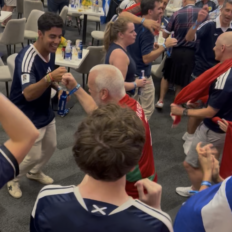
Kyle was fortunate enough to attend two matches and caught enough footage from establishments across the city to fill a phone twice over. The pattern that stuck with him wasn’t about who won, but rather who stayed after the match. People hugged win or lose while dancing around the Putnam Center at Boston Stadium.

Kilts and bagpipes also turned up in rooms miles from the stadium, a constant reminder of the international competition — and the running question of who was playing at any given moment.

While the match itself gave people a reason to be in the room together, what kept everyone there was proximity to strangers who cared, for one night, about the exact same thing they did. This rang true whether you were attending a match or watching from anywhere else around the city.

One moment that stuck with him was at his second match, after Scotland lost to Morocco. When the final whistle sounded, the mood never shifted — a Moroccan fan and a Scottish fan took their jerseys off and swapped right there, dancing together after an embrace. “It was wholesome, and it was unifying,” Kyle said. “You didn’t need to be a fan of either team to feel it.”

The Instinct That Scales Down

Most of what we build doesn’t get that kind of running start. Our clients rarely walk into a room already primed the way sixty-four thousand fans are primed before a World Cup match. But the instinct scales down fine: find where the feeling in the room already wants to go, then build the smallest possible thing that lets people do something with it instead of just standing near it. Boston proved that instinct works even without a script. Our job is making it work for rooms that don’t get one.

Have a project in mind?