Good Activations Start With the Audience, Not the Technology

How Cramer brought an AI-powered projection installation to BNY's INSITE26

The evening party at INSITE26 arrived the way conference nights do — after two days of keynotes, breakout sessions, and a speaker lineup that included the BNY CEO, the head of Carlyle, and Condoleezza Rice. 1,100 financial advisors had spent the week talking about the future of wealth management. Then they walked down a hallway, turned a corner, and stopped.

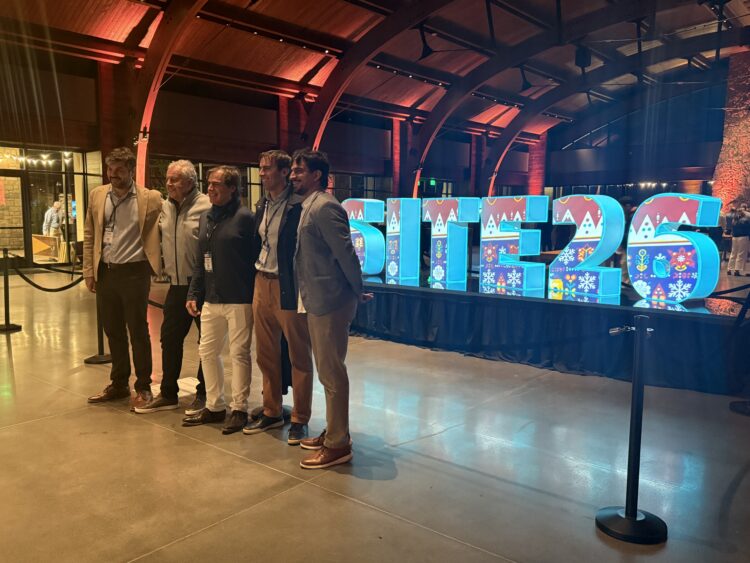
Twenty-one feet of block letters spelling INSITE26 — made from movie prop shop materials, finished in high gloss, sitting on an acrylic floor that amplified every color — were lit from above by a projector mounted twenty feet in the air. The front, the sides, and the top of the letters were all mapped by projection images, not of a sponsor’s logo or of a looping animation, but of AI-Generated paintings that attendees could help develop, derived by prompts that tied to host-city of Denver.
The Mechanic Already Existed

Vincent Higgins, Cramer’s Sr. Director of Creative Technologies, first encountered 11th Dimension on Instagram. The two-person LA-based shop — run by Todd Moyer — had been doing laser graffiti installations at events and festivals. One piece stuck with Higgins: an installation where attendees colored an image on paper, and whatever they drew projected live onto a set of oversized illuminated letters. The mechanic was elegant. People engaged, watched their art scale up in front of them, and photographed it.

So when BNY’s INSITE26 came up as a program, he pitched a version of it. The piece he had to rethink was the input.

Financial advisors at a conference aren’t going to sit down and color— and that’s not a judgment but an honest read of the room. The coloring mechanic would work at a festival because a festival crowd is primed for tactile, unhurried participation. A wealth management conference crowd is primed for something faster, more cognitively engaging, more personally expressive. Asking them to pick up a marker would have generated polite engagement. Maybe a few curious participants. Nothing that travels.

What the Letters Asked

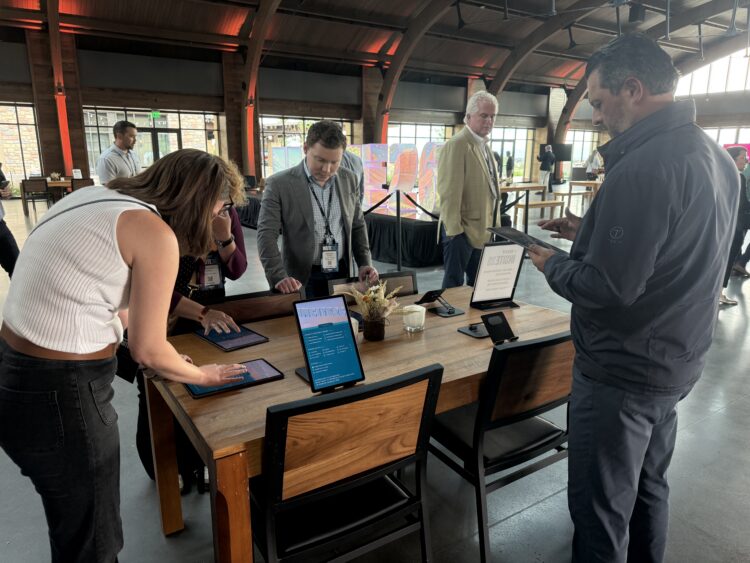
Instead of a coloring page, the activation gave attendees a prompt. Three things about Denver — the city hosting the conference. An art style or artist. A choice of AI model: Gemini Flash, Gemini Pro, or OpenAI’s image generation model. That last variable was Higgins’ addition — his instinct that giving a financially sophisticated audience a visible technical choice would increase engagement rather than complicate it. He was right.

One of six tablets. A few seconds of input. Then the system — built by 11th Dimension in TouchDesigner and powered by Panasonic projection hardware — generated a unique image in the cloud and delivered it, via a QR code assigned to a pre-printed wooden token, to a display that covered an entire room’s worth of illuminated letters.

The wooden token matters. Most activations end at the venue. The generated art stayed hosted online for thirty days after INSITE26 closed, and the token — a piece of laser-engraved wood with a scannable code — went home with the attendee. Scan it a week later, a month later, and the image still pulls up. The keepsake extended the activation past the room. Most don’t.

The Room Takes Over

Over 300 of the 1,100+ attendees ran through the activation — more than a quarter of the room, at a financial conference, generating original art. That doesn’t happen by accident.

Placement helped. The letters sat at the entrance to the party, first thing attendees saw walking in and the last on the way out. People who didn’t generate an image stopped to photograph the letters anyway. People who did came back with friends, scanned the QR code, watched their image fill the letters for about a minute, then watched it cycle into a screensaver playlist of everything the room had made that night. You’r painting. Someone else’s. Hundreds of them, running together.

The UGC followed without being engineered. 11th Dimension’s own Instagram post from the event drew more than 800 likes — from a two-person shop with no website. Attendees posted the letters on their own feeds unprompted. The shareable moment wasn’t grafted onto the activation as an afterthought. It was the activation, because the activation produced something genuinely worth sharing.

What the Technology Didn’t Do

The stack behind the letters was real and considered: TouchDesigner for the projection mapping engine, Panasonic hardware for the image throw, a dual-model AI architecture that gave attendees an actual choice of generation tools. Cramer sourced 11th Dimension based on what Higgins found on Instagram — not through a standard vendor search — and that relationship is exactly the kind of thing that separates a purposefully built activation from a templated one.

None of that is the reason the night worked.

The reason is a question that came earlier in the process: What will this specific audience do? Higgins had a mechanic that worked — proven at a festival, repeatable, visually compelling. He recognized it required a different input for a different room. That recognition, and the willingness to redesign the input rather than deploy the mechanic as-is, is what the letters were built on. The technology delivered what the strategy made room for.

Somewhere, a financial advisor has a wooden token on their desk. The image on it is theirs — built from their read of Denver, their taste in art, their choice of model. Nobody handed it to them. They made it in under a minute, watched it fill a twenty-one-foot installation, and walked home with it.

That’s the distance between an activation that stays and one that clears with the catering.

Have a project in mind?